

Why AI Agents Need Orchestrators
Modularity and the coordination problem behind autonomous systems
The more capable agentic systems become, the less the challenge seems to revolve around the model itself and the more it starts revolving around coordination.
Once agents begin using tools, retrieving information, maintaining memory, looping through decisions, and interacting with external systems, things stop looking like a simple chatbot pretty quickly. You start ending up with something closer to an operational system that needs planning, structure, and supervision to keep functioning coherently.
And that’s the part of the conversation that still feels oddly underdiscussed.
A lot of attention goes toward models and autonomy, but much less toward the layer responsible for coordinating all of this.
That layer is the orchestrator. And the more complex agentic systems become, the more important the orchestration layer becomes.
For builders navigating the move from models to agents
An AI orchestrator serves as the central hub that coordinates interactions between the model, tools, memory stores, APIs, and other external systems. It ensures that AI agents operate effectively and in a controlled manner.
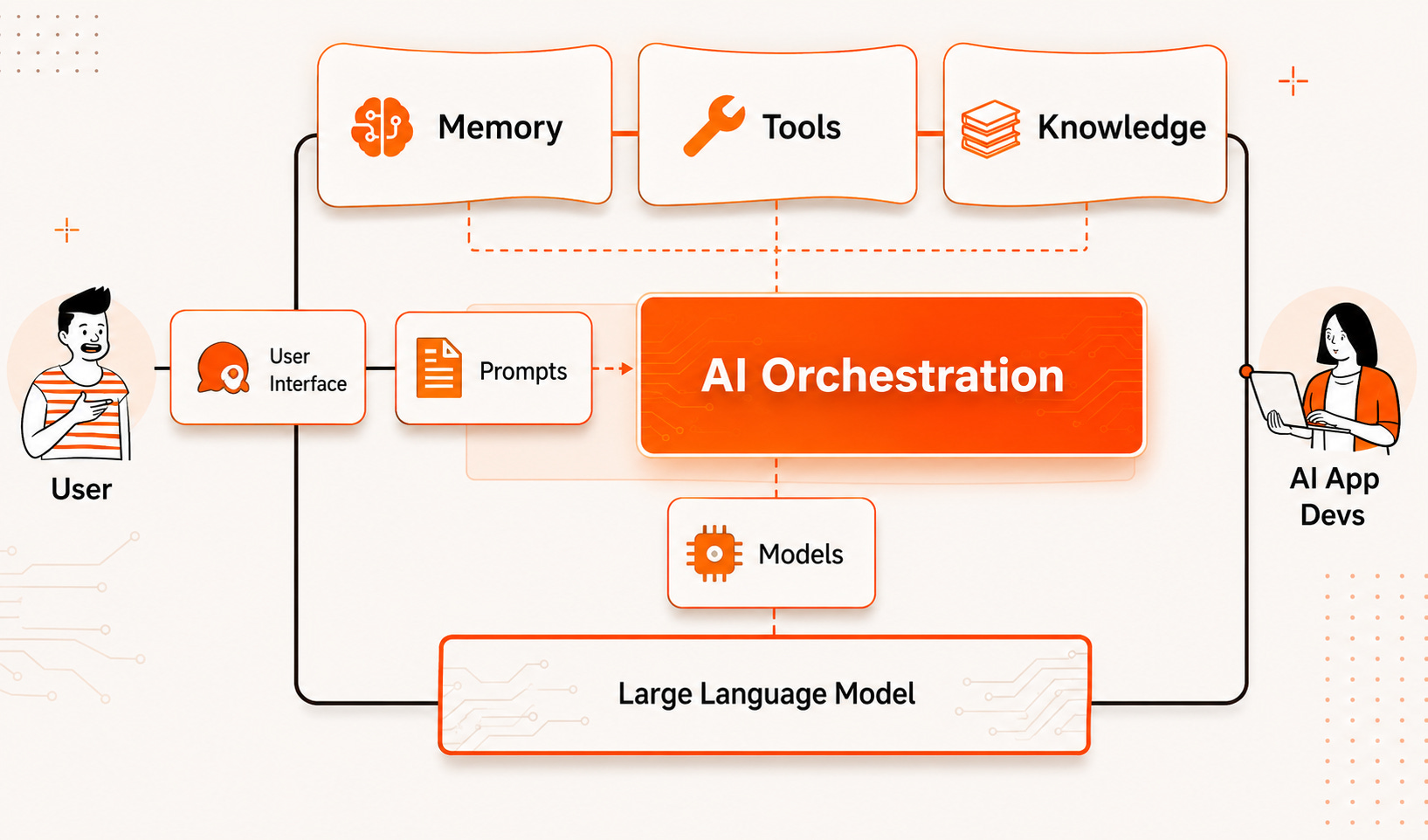
AI orchestrators can help in the following:
Managing complexity: AI workflows often involve multiple coordinated steps such as retrieval, reasoning, and action execution. Orchestrators automate and structure these processes, making systems easier to scale and maintain.
Enhancing scalability: Orchestrators handle high loads by distributing tasks, caching responses, and parallelizing operations—critical for handling multiple users or token-intensive tasks.
Ensuring context awareness: Since LLMs have limited memory, orchestrators integrate vector databases and memory systems to help agents retain information and deliver more coherent, personalized experiences.
Facilitating tool integration: Orchestrators streamline the use of APIs, search engines, and databases by managing task execution and ensuring smooth interaction between LLMs and external tools.
Improving reliability and monitoring: From logging to human-in-the-loop feedback, orchestrators offer tools to catch errors, prevent hallucinations, and ensure systems run securely and reliably.
To better understand the need for an AI orchestrator in the context of AI agents, we need to introduce three key features of AI agents: autonomy, abstraction, and modularity.
Autonomy
Autonomy refers to an AI agent’s capacity to operate independently, making decisions and executing actions without human intervention. This self-directed behavior enables AI agents to perform tasks, adapt to new situations, and pursue goals based on their learned experiences.
The autonomy of an AI agent implies that the steps that the agent is going to take are not necessarily known in advance.
For example, let’s consider a non-agentic workflow as simple as the following:
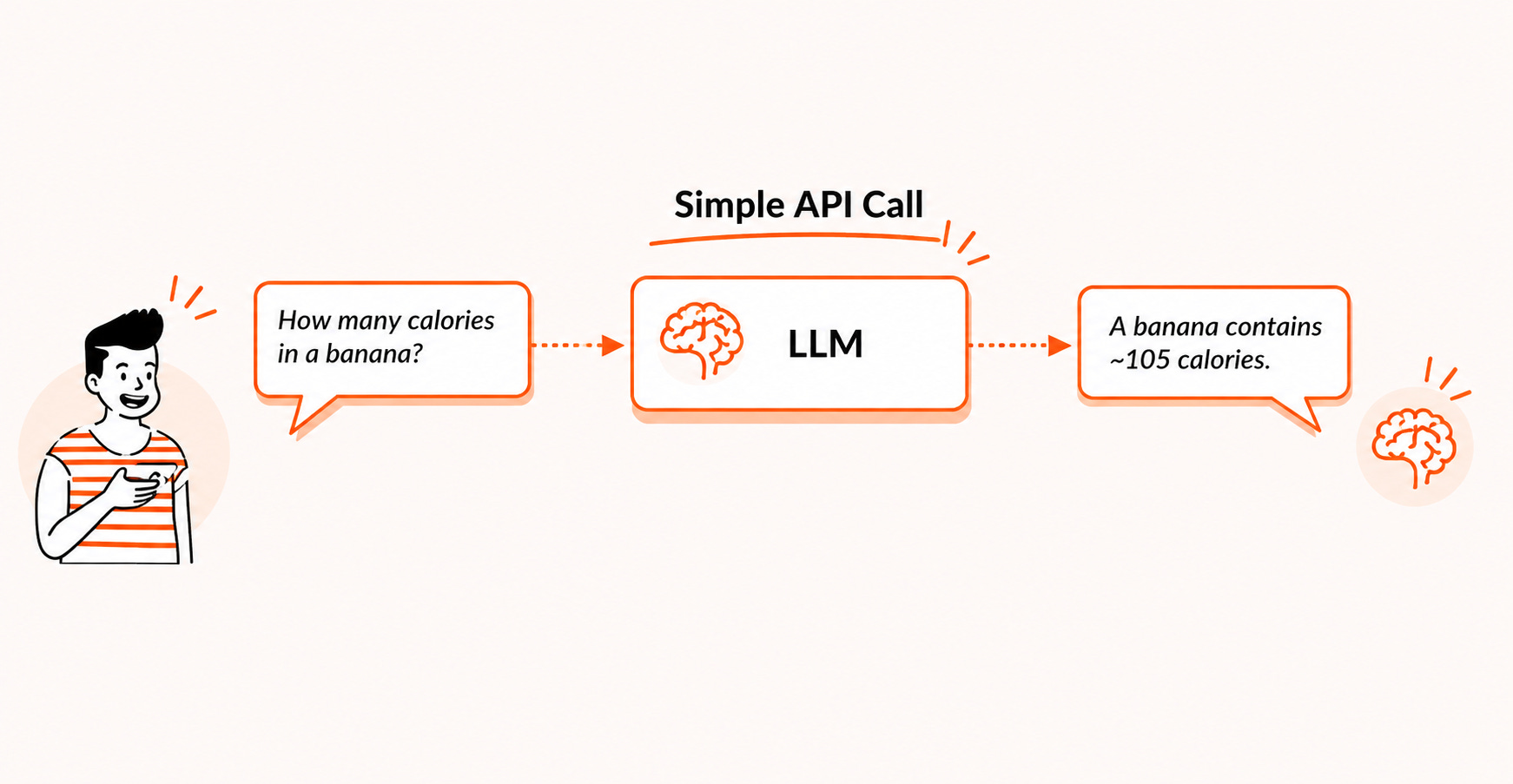
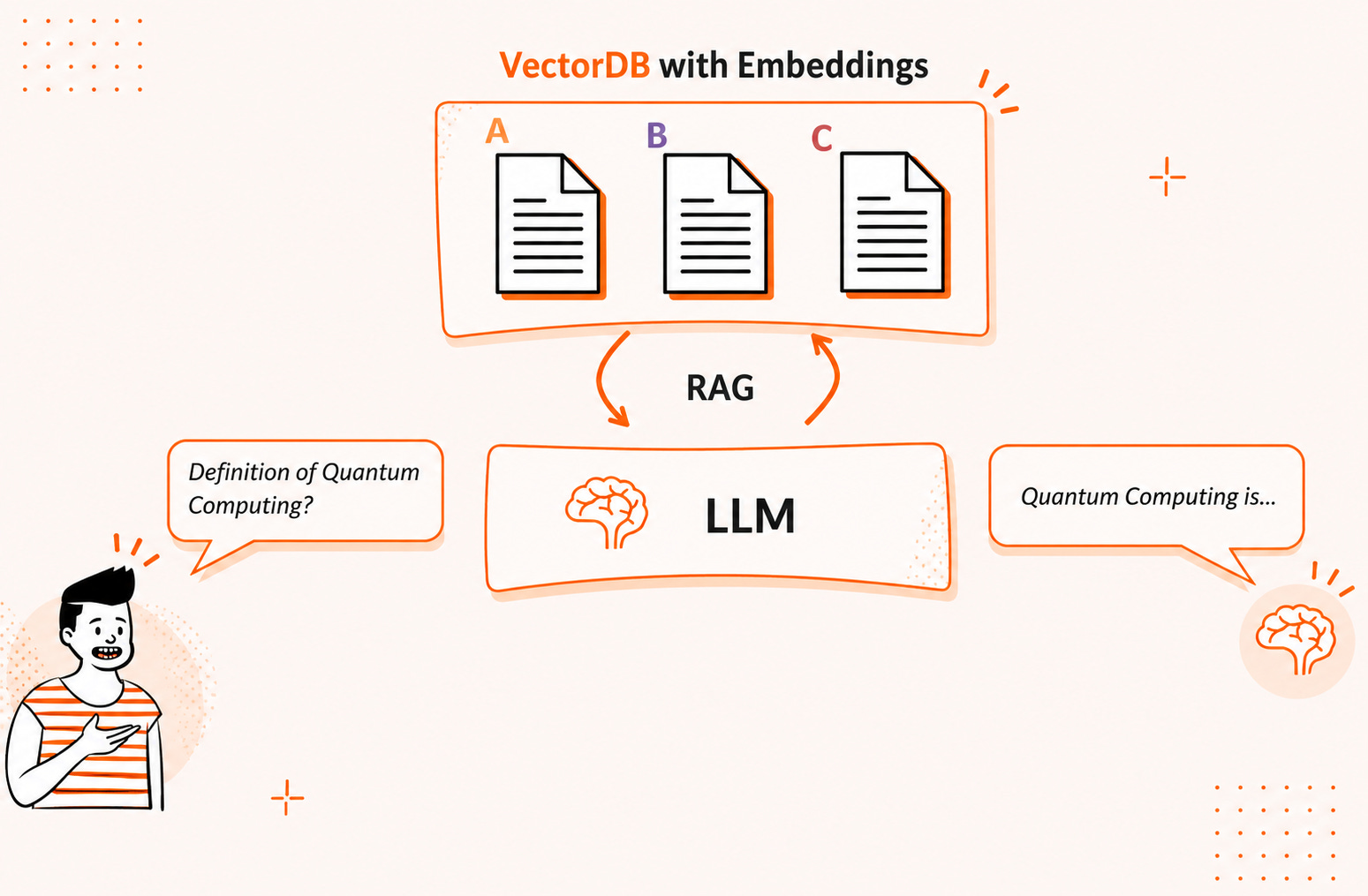
Whenever we prompt an LLM, we are doing an API call, which is the only step that comprises this workflow. Even in the scenario of a retrieval augmented generation (RAG) workflow, steps are known in advance
Let’s now consider an autonomous agentic approach. Let’s say we have an agent with two tools:
Weather tool: a function that takes two parameters: city and unit of measurement.
Location tool: a function that takes the current position of the user, leveraging the GPS position. This function takes no parameters.
Both functions come with a natural language description, as per the AI agent’s anatomy. Our workflow design will let the agent decide which tool to invoke
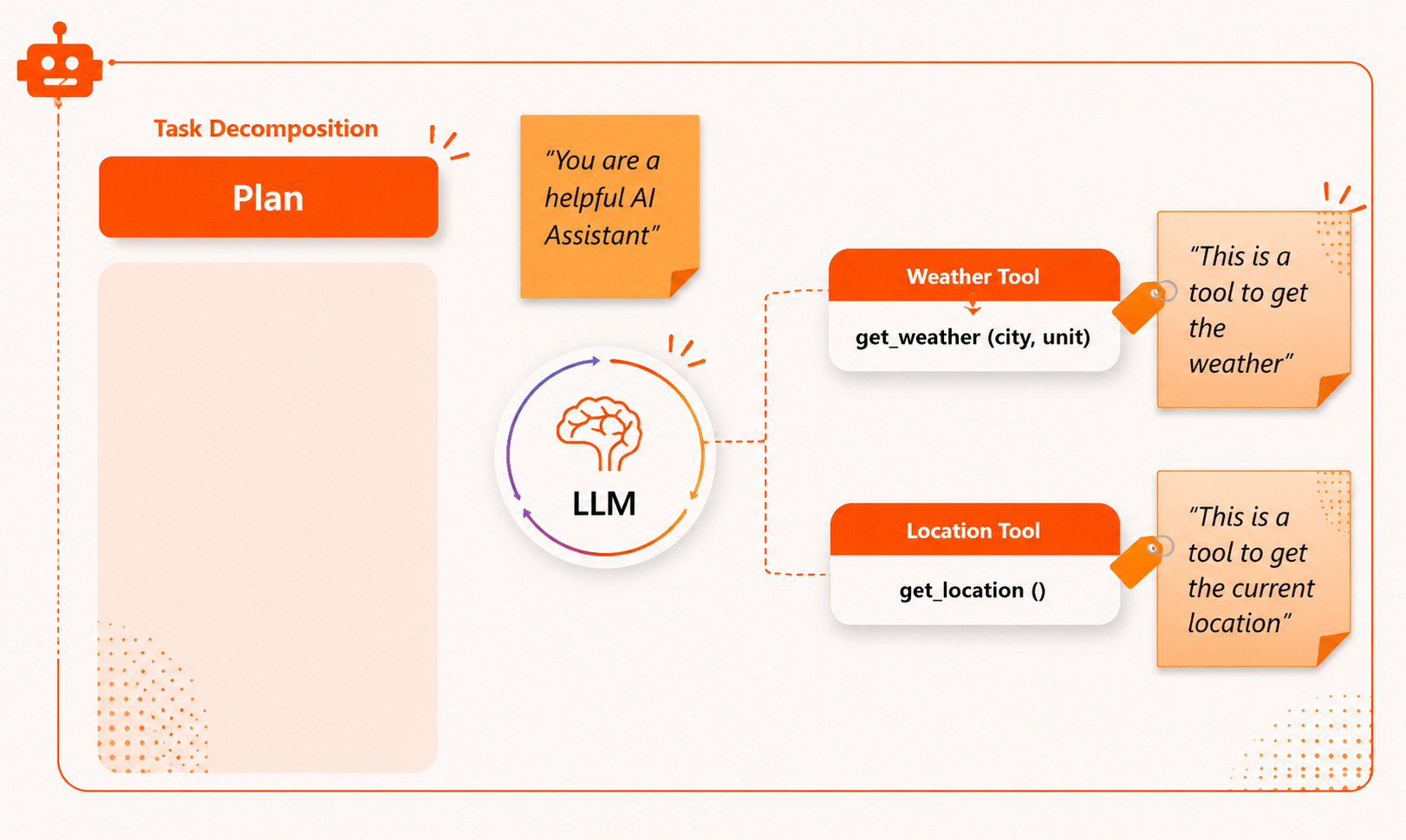
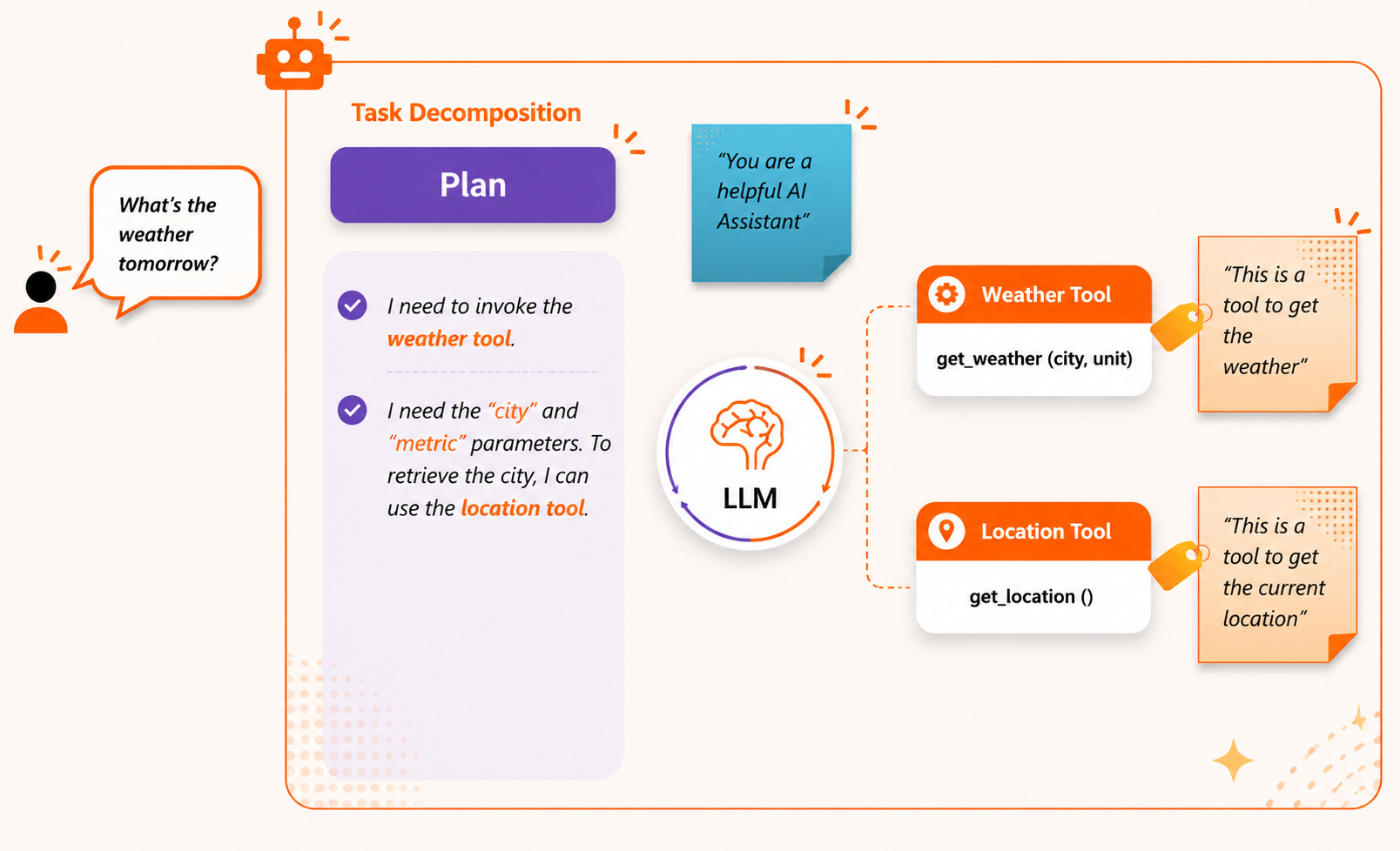
Let’s say that a new user asks, “What’s the weather for tomorrow?” The following things will happen:
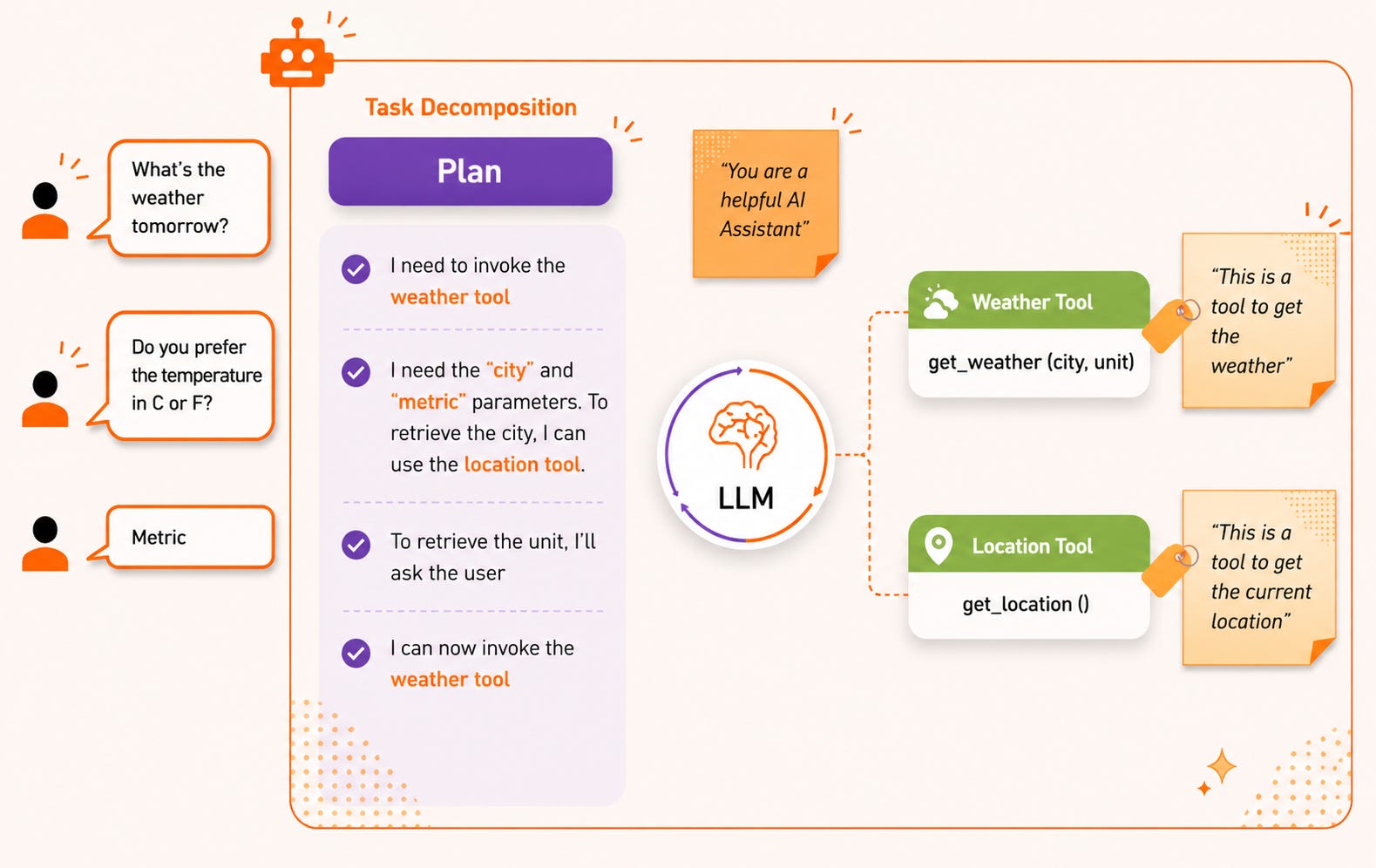
The agent will read through the descriptions of its tools and understand that it needs to invoke the weather tool. However, it’s missing the two parameters, but thanks to its autonomy, it can look around to retrieve them. It soon understands that it can leverage the location tool to get the first parameter: the output of that function will serve as the parameter of the weather tool.
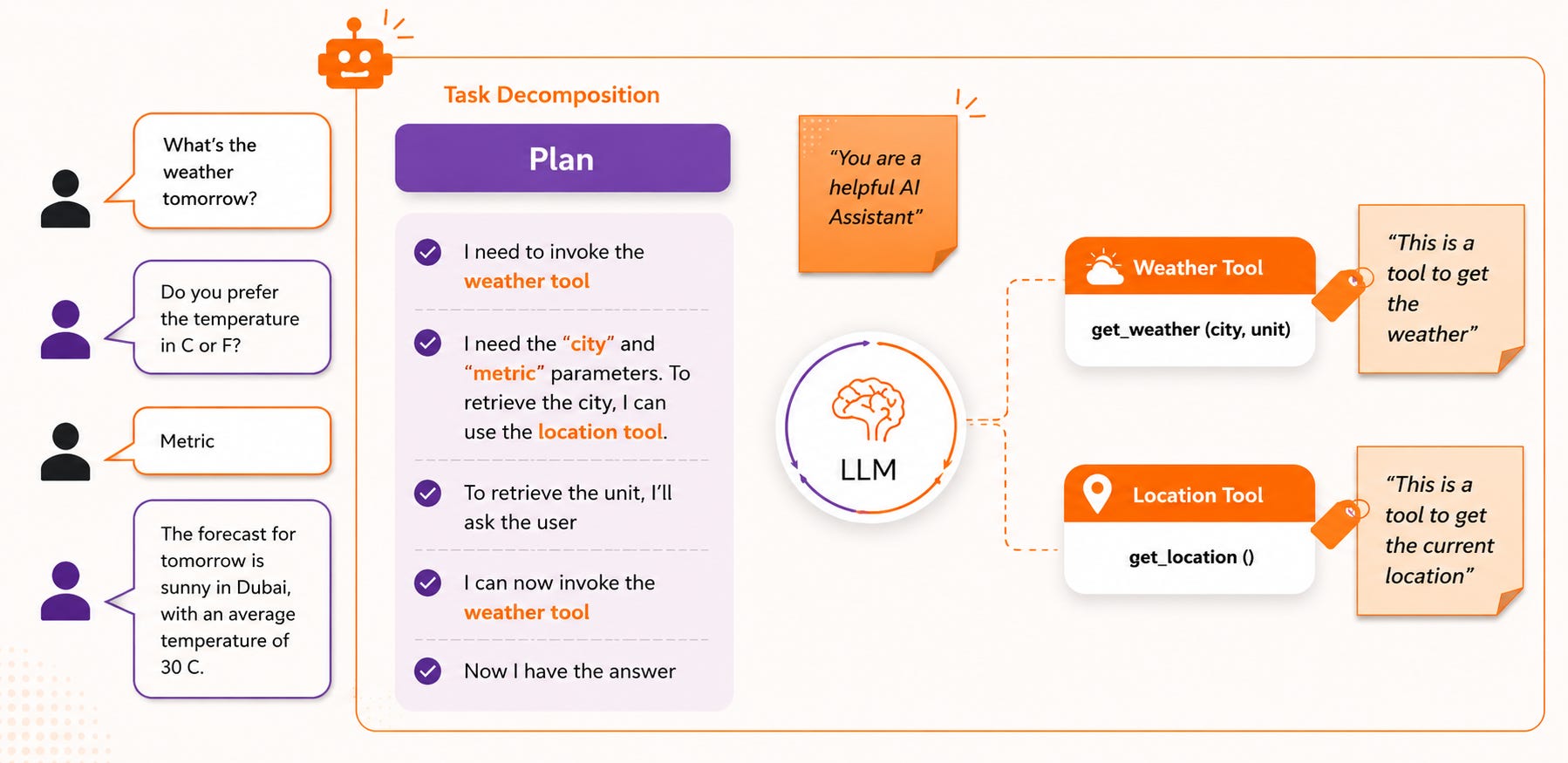
For the second parameter, the agent cannot make it alone: it needs to ask the user. So it does, asking the user which kind of unit of measurement is needed. Once the user responds, the agent is able to properly invoke the tool with both parameters.
The agent observes the output of the weather tool and ascertains that it now knows the final answer for the user.
Can you imagine how many “if…else” statements would have been needed to replicate such a degree of autonomy in a standard Robotic Process Automation (RPA) process? And even if we could manage a similar scenario, what if the user asks something that has not been hardcoded in the process? Adaptability, self-critique, and self-adjustment are key features of agentic autonomy.
There are many degrees of autonomy we can provide our agents with: it all boils down to the workflow we set up and the planning strategy we instruct our agents to follow. Designing the proper agentic workflow is an architectural design conversation that is core when building your agentic state.
Abstraction and modularity
Abstraction refers to breaking down and simplifying complexity. It is what makes these systems comprehensible and scalable. But beyond simplification, it also enables modular design, a fundamental principle in building intelligent systems.
Modularity breaks down complex problems into smaller, reusable components, each handling a specific part of the challenge. This approach offers several advantages:
Interchangeability: Components can be swapped, upgraded, or replaced without affecting the entire system
Reusability: Well-designed modules can be repurposed across different projects, improving efficiency
Scalability: Independent yet seamlessly integrated components make it easier to expand solutions
In multi-agent systems, abstraction and modularity allow for the creation of cooperative agents, each specializing in specific tasks while interacting dynamically. This mirrors human problem-solving, where we divide, delegate, and collaborate to tackle complexity effectively.
A great way to understand abstraction and modularity in agentic patterns is by looking at a multi-agent traffic management system in a busy metropolitan city, where different levels of agents handle different levels of abstraction, ensuring smooth operation without overwhelming any single entity.
A standalone agent can always be consumed by another agent as a “tool” with the very same approach of coming with a natural language description of its capabilities. For example, an “SQL agent” can be a tool for a “project manager agent,” the moment the latter needs to query an SQL database.
At the most granular level, we have intersection controllers, which operate at a single traffic light or intersection. These agents rely on real-time data from cameras and sensors to adjust traffic signals based on vehicle congestion, pedestrian movement, and emergency vehicle priority.
They don’t worry about what’s happening in the next city block or the broader urban landscape; their only job is to optimize traffic flow at their specific location. If a sudden influx of cars appears at a junction, they may extend green-light durations to ease congestion.
Zooming out, we have district-level traffic coordinators. These agents don’t micromanage individual traffic lights but instead analyze traffic flow across multiple intersections within a neighborhood or district.
They use data from intersection controllers, GPS tracking, and public transport systems to identify congestion patterns, reroute vehicles, and balance the flow of cars across the area. If they detect excessive delays in one zone, they adjust how much time a light is on for the traffic signal for multiple intersections rather than just one.
More importantly, they direct intersection-level agents, ensuring their adjustments align with broader district-wide traffic goals.
At the highest level, we have the citywide traffic management system, responsible for optimizing the flow of millions of vehicles across the entire metropolitan area. This agent doesn’t focus on specific traffic lights or individual congestion points; instead, it allocates resources, predicts long-term patterns, and makes strategic adjustments.
Using data from weather reports, major event schedules, accidents, and public transportation networks, this agent might reroute entire roads, coordinate construction schedules to minimize disruption, or implement city-wide emergency response plans in case of major incidents.
If an accident occurs on a major highway, the citywide system redirects district-level agents to adjust traffic patterns, which in turn instructs intersection controllers to reroute vehicles efficiently.
This layered structure demonstrates the power of abstraction and modularity in multi-agent systems:
Intersection agents handle local, real-time decisions, adjusting traffic lights and prioritizing immediate flow
District-level agents analyze and coordinate groups of intersections, optimizing traffic across a wider region
Citywide agents focus on the big picture, planning for long-term efficiency, emergency responses, and systemic optimizations
This mirrors how software architectures, AI systems, and even corporate structures function in the real world. Whether it’s frontline workers executing tasks, middle managers coordinating efforts, or executives setting the overall vision, abstraction enables complex systems to remain scalable, efficient, and resilient.
By designing multi-agent AI architectures with this layered approach, we ensure each agent focuses only on what it needs to handle, preventing system overload and enabling adaptive, real-time decision-making at scale, just like a smart traffic system managing a bustling city.
If this doesn’t sound like a real thing to you, let’s have a look at OpenAI’s tool called Operator, which acts as an autonomous agent, capable of performing tasks in a web browser, such as booking tickets or filling online orders.
OpenAI’s Operator follows a hierarchical multi-agent approach similar to the traffic management system. Each agent operates at a different level of abstraction, ensuring efficiency and adaptability without overwhelming any single component.
Web controllers (low-level agents): These agents handle execution: moving the mouse, clicking buttons, and entering text. They don’t analyze or plan—they simply follow commands.
Vision and reasoning (mid-level agents): These agents interpret the web interface. The Vision Agent processes screenshots, detecting relevant elements, while the Reasoning Agent determines the next action (clicking, typing, or scrolling). This layer abstracts away the details of execution, focusing on understanding and decision-making.
The planner/orchestrator (high-level agent): The top-level agent oversees the entire system, ensuring that web interactions align with broader goals—whether it’s searching for information or filling out a form. It delegates tasks to mid-level agents, ensuring smooth and strategic navigation.
This structured approach highlights why abstraction matters so much in multi-agent design. Low-level agents can focus purely on execution without needing to reason about broader objectives, while mid-level agents handle interpretation, coordination, and planning across tasks. Above them, high-level agents manage overall strategy and orchestration without getting pulled into implementation details. Separating responsibilities this way allows complex systems to remain scalable, adaptable, and manageable without overwhelming any single layer of the architecture.
By leveraging this modular design, OpenAI’s Operator adapts dynamically, handling different websites without requiring manual programming. This scalable and generalizable architecture is a prime example of how multi-agent systems drive real-world AI applications.
From an architectural perspective, all these components – agents, skills, plugins – can be seen as repeatable assets in your organization. In this context, AI orchestrators ensure that these components work together without being tightly coupled, preventing complexity from overwhelming the system.
Following the preceding hierarchical example, with an AI orchestrator, you can easily define the following:
Execution agents (low-level): These handle raw tasks such as API calls, database queries, or web scraping, executing commands without decision-making
Reasoning agents (mid-level): They analyze data, determine actions, and select the right tools, abstracting execution details
Orchestration and planning (high-level): The orchestrator oversees workflows, breaking down tasks, distributing them across agents, and adapting dynamically
By structuring AI systems this way, orchestrators enable adaptive, generalizable intelligence, ensuring seamless interaction between components without manual intervention.
This excerpt was adapted from AI Agents in Practice by Valentina Alto, which does an excellent job of grounding these ideas in real architectural patterns instead of treating agents as abstract autonomous magic. The book goes deep into orchestration frameworks, multi-agent systems, memory architectures, tooling, production deployment, and the operational realities of building AI agents that can function beyond demos.
If you’ve been trying to separate what’s structurally important in the agent ecosystem, this book is worth spending time with.